
Digital Age Jargon Explained: Ghost Launches, AI-Horning and Enshittification
Not financial advice. For satirical purposes only.
The digital age keeps coughing up new jargon the way a malfunctioning vending machine keeps spitting out the same sticky snacks. Ghost launches, broligarchies, AI-horning—each term lands like a fresh bruise on the collective eyeball, naming the ridiculous machinery we all keep feeding.
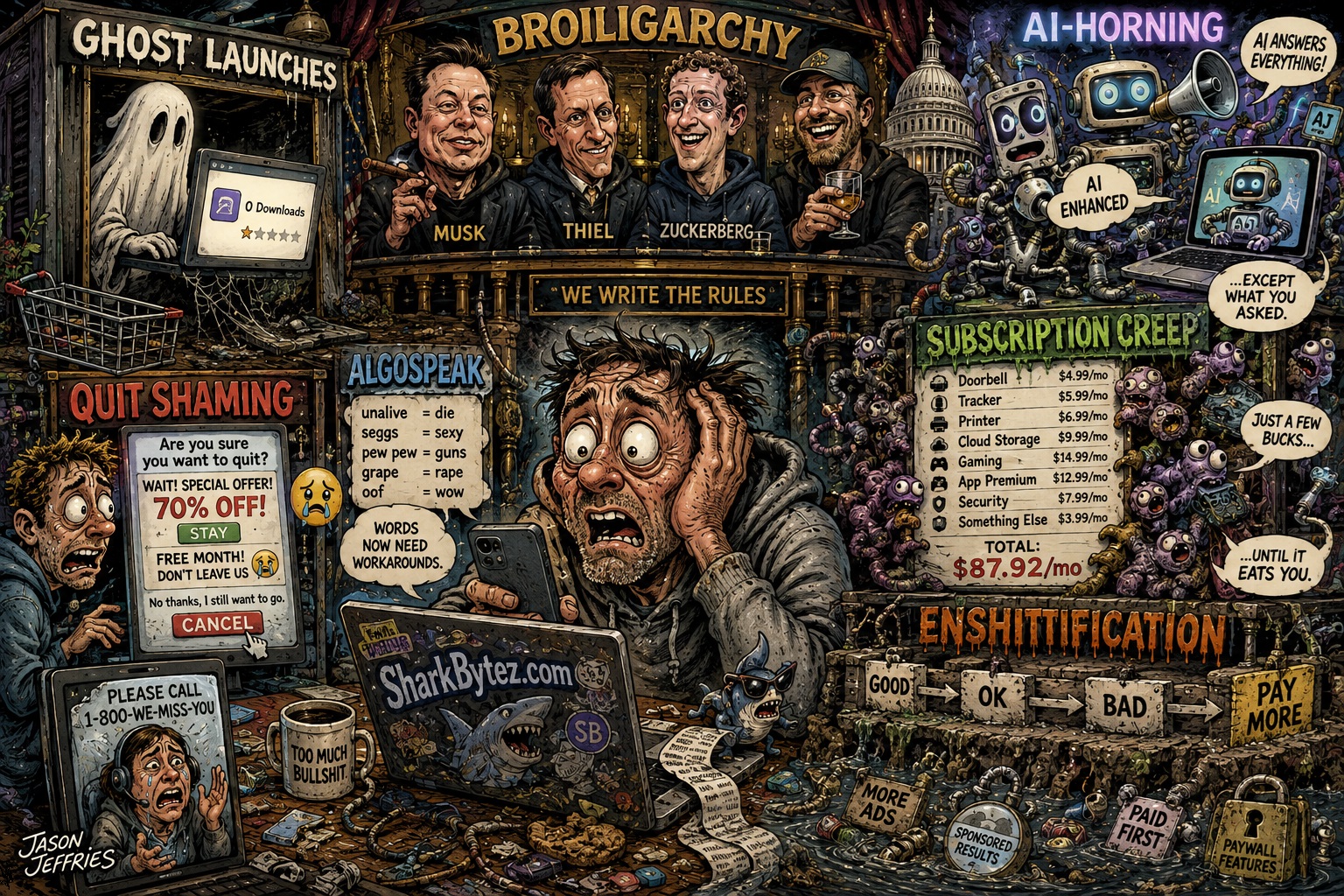
Ghost launching is the art of dumping a half-finished product onto the internet and then hiding behind the curtains to watch what happens. No press release, no launch party, just a lonely app-store listing sitting there like an abandoned shopping cart in a parking lot at 3 a.m. Sometimes curious strangers wander by and poke it. Most times the thing just gathers digital lint while the founders refresh analytics and pretend they meant to be mysterious all along.
Broligarchy describes the compact fraternity of ultra-rich tech operators who treat politics like another side hustle. Musk, Thiel, Zuckerberg and the rest do not merely hire lobbyists; they stroll into the rooms where rules get written, contracts get handed out, and influence compounds faster than any stock ticker. Wealth becomes a direct pipeline to power, and the rest of us get front-row seats to the spectacle of hoodies rewriting the operating system of government.
AI-horning is the unstoppable weed growth of artificial intelligence into every digital crevice that never asked for it. Search results arrive pre-chewed, playlists sprout robotic DJs, image feeds fill with synthetic faces that look almost human if you squint hard enough, and even the most basic tools suddenly sport chatbots that answer every question except the one you typed. The result is often slower, costlier, and more confusing than the plain version that worked yesterday—yet the feature flags keep flipping on.
Quit shaming turns the simple act of leaving into an obstacle course designed by someone who hates joy. Click cancel and a cascade of desperate offers appears: discounts, free months, guilt-laden pop-ups that practically beg on their digital knees. Some platforms still demand a phone call, as if walking away requires a formal exit interview conducted by a sad customer-service agent reading from a script.
Algospeak is the linguistic contortionism required to stay visible. Creators swap “unalive” for die, “seggs” for anything steamy, “pew pew” for firearms, turning everyday speech into a coded dance around automated filters that mistake context for crime. The workaround works until the machines catch up and the whole charade collapses under its own cleverness.
Subscription creep is the quiet multiplication of tiny monthly charges that breed in the dark corners of your bank statement. Doorbells, trackers, printers, consoles—each one adds another quiet drain until the total looks like a digital barnacle colony that no one remembers inviting. Useful services become the bait that justifies the rest of the infestation.
And enshittification remains the grand finale: the deliberate slide of platforms from useful to extractive. Feeds favor ads over actual friends, search results push sponsors, marketplaces bury genuine options under paid listings, and even hardware starts locking features behind new fees. Quality decays on a schedule while the metrics keep climbing and the executives keep smiling.
Together these terms map a landscape where convenience multiplies the hassle, power concentrates in fewer hands, and the language itself has to keep inventing new names for the same old squeeze. The digital era did not just expand. It learned to describe its own excesses with the precision of a surgeon who cannot stop operating.
Shark Cage - A SharkBytez Trusted Partner
Are you interested in online trading? Try our trusted platform, Margex — up to 100x leverage on a fast, no-KYC exchange.