

Massive Viking Treasure Found Beneath a Danish Backyar
Not financial advice. For satirical purposes only.
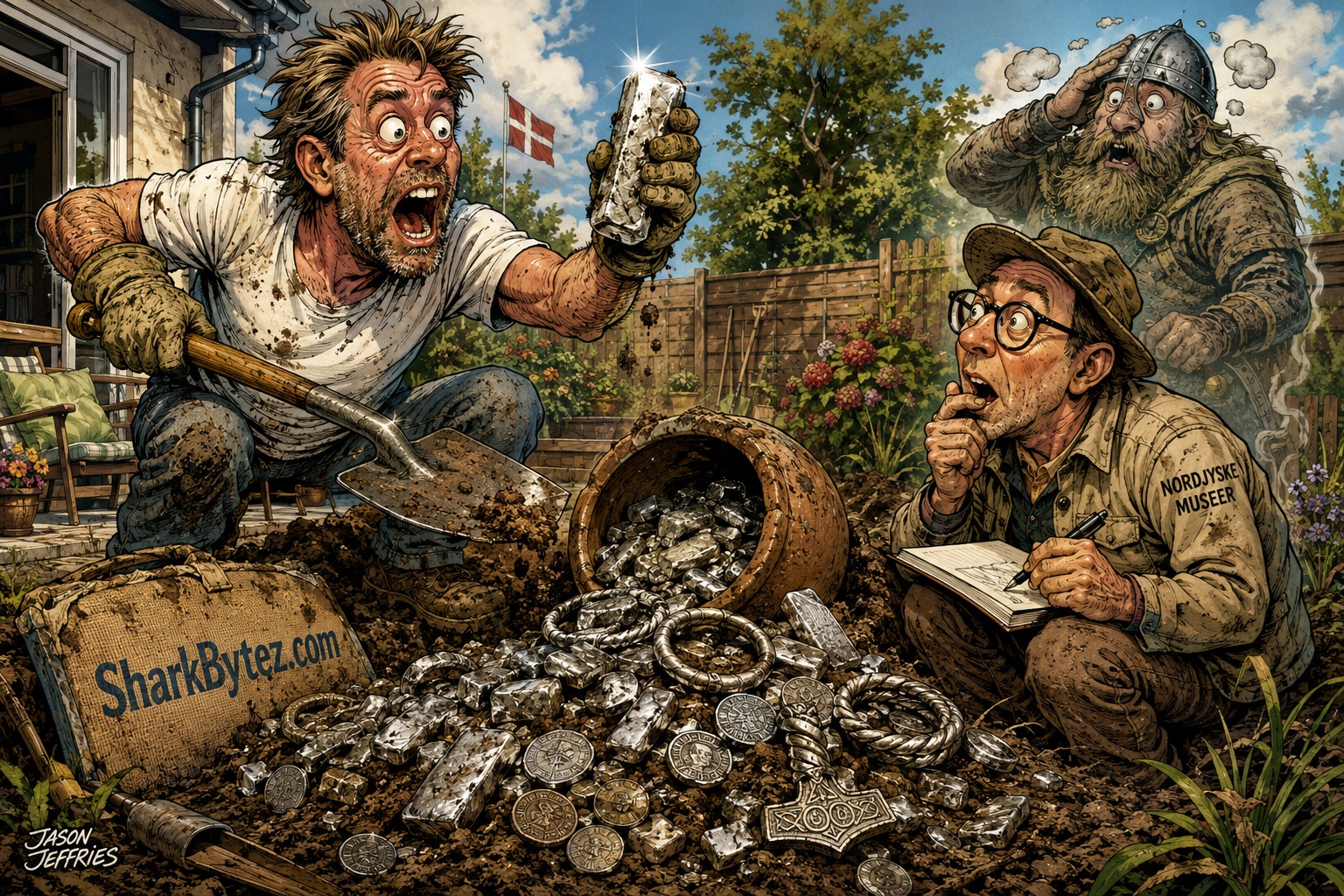
A Rebild homeowner swings a shovel at stubborn patio dirt and clocks 18.5 kilograms of Viking silver—nearly three times Denmark’s previous record—like the ground itself decided to cough up a millennium of unpaid debts. What should have been an afternoon of gravel and grass turns into the country’s largest known Viking Age silver hoard: roughly 700 bars, chopped jewelry, arm rings, 47 coins and fragments, and one undersized Thor’s hammer still parked inside its original clay pot like a houseguest who never got the hint to leave. About 6.4 kilos stayed neatly packed in the vessel; the rest spilled into the surrounding soil in a glittering mess that looked less like careful burial and more like someone had dropped a sack of portable wealth while running for the door.
The coins supply the purest visual punchline. Arabic dirhams from the Islamic world share the same dirt as English pennies struck under Edward the Elder, one of them minted in Viking-ruled York around 921–925. The whole stash got shoved into quiet North Jutland soil sometime in the 900s, yet it advertises long-haul trade routes stretching east to Baghdad and west to England as if the Rebild backyard had once doubled as a busy currency exchange. Nordjyske Museer’s Torben Sarauw calls it the equivalent of cracking a Viking safe. The comparison almost sticks: silver then traveled by weight, melted and sliced into convenient lumps, and this cache shows the system operating at scale in a landscape modern maps treat as scenic walking country.
Rebild has developed a habit of spitting metal. A 1971 silver hoard weighed about four kilos. Earlier this year the nearby Rold gold rings—six intact arm rings totaling 762.5 grams—surfaced beside a forest track. Same stretch of northern Jutland, different shiny interruption. Researchers correctly note the concentration proves deep economic ties across Scandinavia, the Baltic, Western Europe and the Islamic world. It also proves the region’s long-standing talent for parking serious money underground and then vanishing before the receipt could be requested.
Danish law labels the lot Danefæ, state property. The anonymous finder collects a reward based on material value plus a finder’s fee; the National Museum sizes it up; Nordjyske Museer hopes to park both the silver and the Rold gold at the Fyrkat Viking Museum so visitors can stare at the evidence of ancient commerce while standing inside an actual ring fortress. Why the hoard was buried remains a blank. The modern garden sits in a built-up area, so full excavation stays off the table. Settlement, trade route, or deliberate isolation—pick your theory. The Vikings left the silver and zero explanatory footnote.
The timing is almost too clean. A thousand years of careful concealment undone by the simple urge for better outdoor seating. Global networks reduced to patio gravel. Experts rightly celebrate a major economic document while the rest of us picture some 10th-century operator carefully packing his portable fortune only for a 21st-century homeowner to interrupt the silence with a shovel and a weekend project. History rarely delivers its punch lines with such dirt-covered precision.
Shark Cage - A SharkBytez Trusted Partner
Looking to buy physical gold or silver? Money Metals Exchange is who we trust for low premiums and fast shipping.