Stocks Bytez
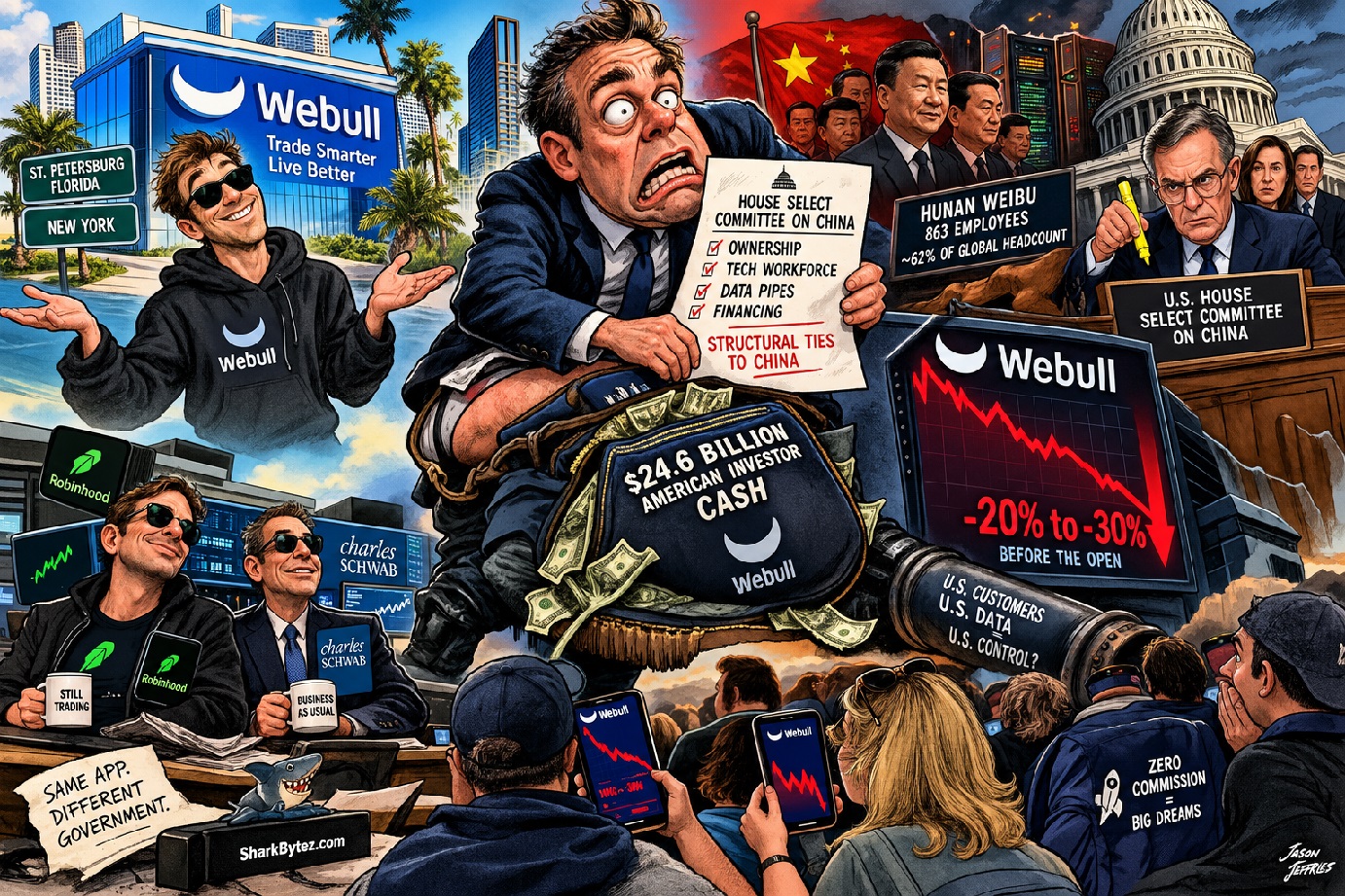
Webull just got yanked into the congressional glare like a flashy trading app that showed up to a black-tie dinner still wearing its startup hoodie. A House Select Committee on China report landed Wednesday and declared the platform structurally welded to the Chinese government—ownership, tech workforce, data pipes, financing, the entire interlocking skeleton. Shares responded by performing a full Olympic dive, plunging twenty to thirty percent before the opening bell even finished its coffee. The committee’s version of events is pure visual comedy. Webull sells itself as the friendly American brokerage with sunny headquarters in St. Petersburg, Florida, and a New York outpost. Meanwhile a mainland subsidiary named Hunan Weibu employs 863 people—roughly sixty-two percent of the global headcount—and apparently keeps the technological engine running. Once the company started holding customer cash directly in late 2025, the exposure jumped from theoretical to concrete: about 24.6 billion dollars of American investor money sitting inside a corporate structure subject to Chinese law. The report calls the distance between the marketing brochure and the actual wiring diagram a “profound gap.” Webull’s response arrived dressed in corporate formalwear. U.S. customer data lives on American soil, access stays under U.S. control, headquarters are right here in Florida and New York, and the committee somehow produced significant inaccuracies without enough clarifying questions. The statement reads like a firm that has practiced this exact defense in front of a bathroom mirror until the delivery was perfect. Robinhood and Charles Schwab—actual homegrown competitors—watched the whole spectacle from a polite distance while their own shares barely twitched. The contrast is almost theatrical. One platform gets the national-security spotlight and a red candle the size of a small skyscraper. The others keep processing trades without the same structural questions hovering over the server racks. This is modern American finance theater at its finest. Retail investors chase the sleekest zero-commission apps promising democratized markets and instant thrills. Capital sprints toward the flashiest interface. Somewhere in the fine print the question of who actually builds the technology and who ultimately answers to which government gets treated like optional reading material. Congress eventually shows up with a highlighter the size of a billboard. The stock chart finishes the punchline in bright red ink. No teams, no cheerleading. Just the familiar American tension between open markets and hard security realities. Webull insists the gap is imaginary. The committee insists the gap is structural. The share price, for one loud afternoon, has already voted. The rest of the market will keep refreshing to see whether this stays a one-day bloodbath or turns into the longer regulatory conversation every fintech with cross-border roots will eventually have to face.
Read more →