


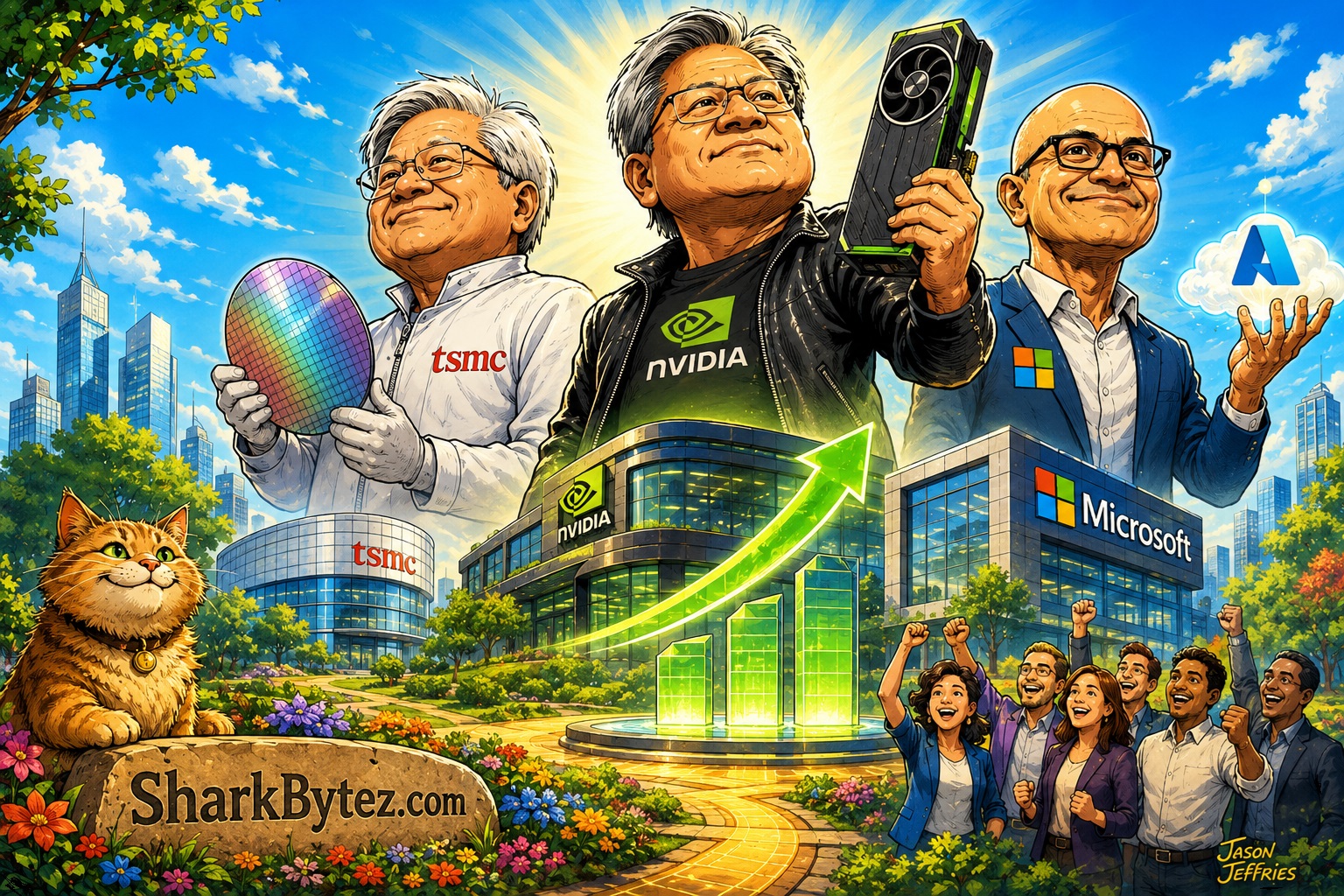
3 Tech Stocks You Never Need to Sell:The Core Holdings
Not financial advice. For satirical purposes only.
High equity valuations make most people twitchy. The CAPE ratio has been perched up there like a cat that just knocked a priceless vase off the shelf and is now casually licking its paw, waiting to see who flinches first. History remembers what usually follows those stretches. Yet the smarter move is not to bolt for the exits. It is to stop chasing the speculative fireworks and start owning the three companies that actually print the cash the entire technology stack runs on.
Nvidia, Microsoft, and Taiwan Semiconductor Manufacturing form a self-reinforcing flywheel so tightly locked that trying to pry it apart feels like arguing with a brick wall that also happens to own the brick factory. TSMC fabricates the advanced silicon. Nvidia turns those chips into the dominant accelerated computing platform. Microsoft then monetizes the software layer across global enterprises with the calm efficiency of a company that already has a key to every office building on the planet. The result is less a temporary boom and more a permanent infrastructure toll booth that never closes.
Nvidia’s real edge lives deeper than the GPUs that dominate every artificial intelligence headline. Its CUDA software platform has effectively locked millions of developers into its hardware architecture the way a popular operating system once locked an entire generation of users into buying the same brand of computer year after year. Once that ecosystem is built, switching costs become enormous. Short-term CapEx cycles will still produce volatility. That is simply the price of admission for owning the compute engine that trains and deploys the models everyone else is racing to use.
Microsoft plays a different game. If Nvidia builds the roads, Microsoft collects the tolls while already sitting inside the daily workflow of millions of enterprises. Azure and Microsoft 365 convert corporate IT budgets into high-margin recurring revenue with a regularity that would make most software startups look like they are still selling lemonade on the sidewalk. Adding intelligent automation on top of that existing distribution is less a speculative bet and more a logical extension of an already dominant position.
Then there is TSMC. Regardless of which chip designer or software brand grabs the headlines this week, the most advanced silicon still has to pass through its foundries. Controlling more than 70 percent of global production at the leading nodes gives the company a near-monopoly that only grows more valuable as designs become more complex and capital-intensive. Apple, Nvidia, AMD, and Broadcom all depend on it. That is not a temporary advantage. It is structural.
Market cycles will keep creating noise. Multiples will compress and expand. Short-term price swings will continue to test nerves. None of that changes the underlying reality. Businesses with fortress balance sheets, pricing power, and genuine economic moats remain the primary engines of long-term wealth in technology. Owning them is not about timing the perfect entry. It is about recognizing that the global economy increasingly runs on the infrastructure these three companies control.
Shark Cage - A SharkBytez Trusted Partner
Are you interested in online trading? Try our trusted platform, Margex — up to 100x leverage on a fast, no-KYC exchange.