

Microsoft Starts Charging Rent
Not financial advice. For satirical purposes only.
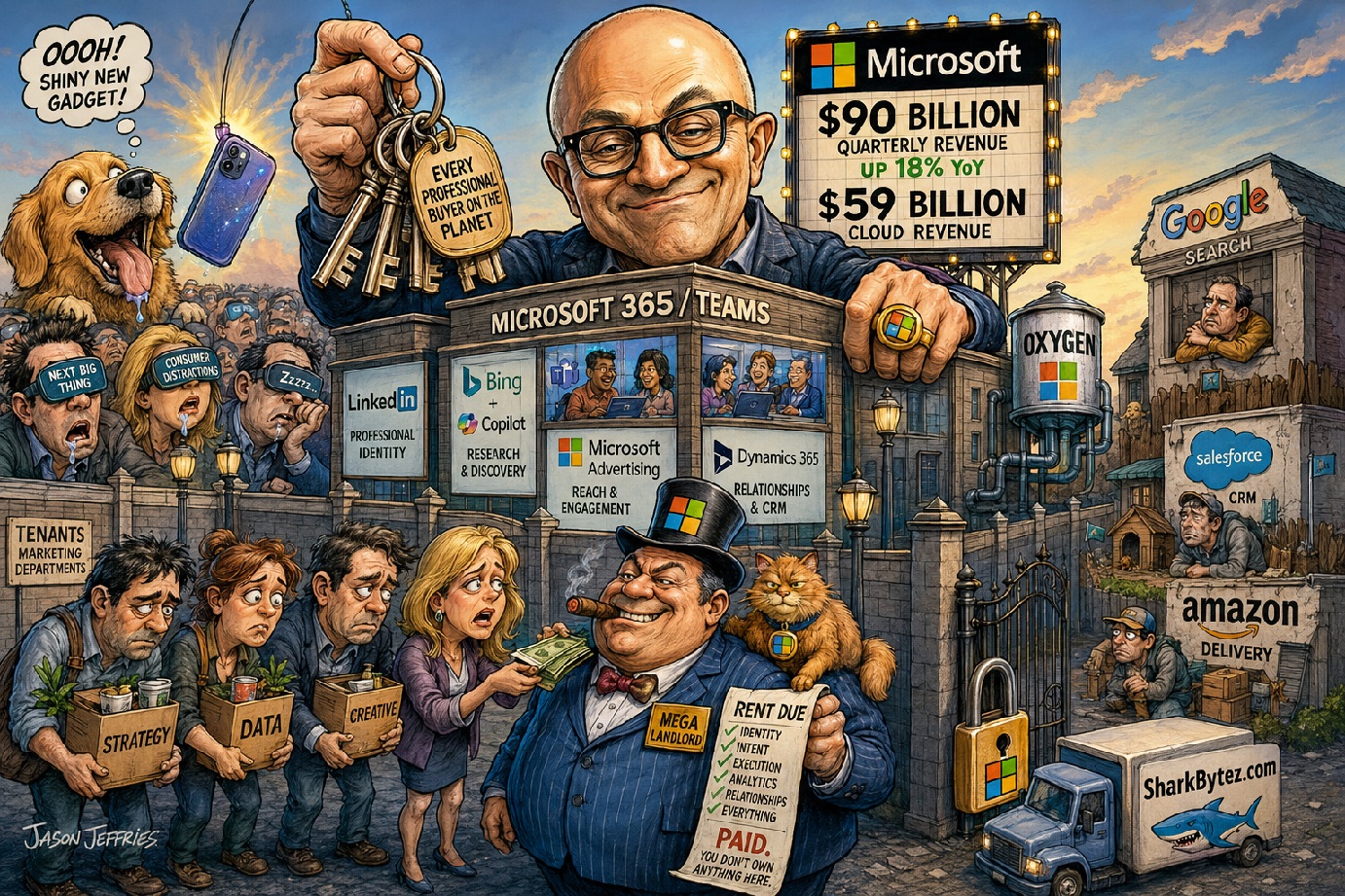
While the marketing world spent a solid decade drooling over the next shiny consumer gadget like a golden retriever watching a tennis ball, Microsoft was out back quietly buying the entire professional neighborhood. Not with fireworks. Not with a dramatic villain monologue. Just the patient, glacial, slightly creepy patience of a landlord who already owns the building, the streetlights, the parking spots, and—oh yeah—the oxygen.
Recent earnings casually dropped a **$90 billion** quarterly haul (up 18% YoY) while cloud ops alone cleared **$59 billion**. Impressive numbers. The real masterpiece is the architecture those numbers bought.
Professional identity now lives on LinkedIn.
Research begins with Bing + Copilot.
Ads run through Microsoft Advertising.
Relationships get tracked in Dynamics.
The entire workday unfolds inside the Microsoft 365 / Teams multiplex.
Google owns search.
Salesforce owns CRM.
Amazon moves the boxes.
None of them control every single door, hallway, light switch, *and* the air you breathe.
Microsoft does.
For marketers this feels like discovering your friendly local landlord has purchased the whole city block, the highway on-ramp, the coffee shop, the oxygen franchise, *and* the emergency exits. The sales pitch is pure comfort food: “One unified view of the buyer! No more Frankenstein tech stacks! No more guessing what a corporate buyer wants when they’ve already posted their entire professional soul (and lunch preferences) on a platform you must *pay* to reach!”
The hangover is less cozy.
Marketers are no longer architects of independent strategy.
They are tenants.
Renting floor space.
From a single mega-landlord who holds the keys to every professional buyer on the planet and can change the locks whenever the mood strikes.
It is the classic walled-garden problem stretched across the *entire* commercial lifecycle—identity, intent, execution, all under one roof—while everyone else is still arguing about whose garden wall is prettier.
The truly comic part is how it happened.
No dramatic vote.
No public referendum.
No dramatic boardroom betrayal.
Just one quiet software update after another while the rest of the industry was staring at the latest consumer distraction like it was the second coming of the iPhone.
Microsoft did not sneak up on the industry.
The industry simply dozed off…
…and woke up paying rent.