

Berkshire Hathaway’s $400 Billion Cash Problem
Not financial advice. For satirical purposes only.
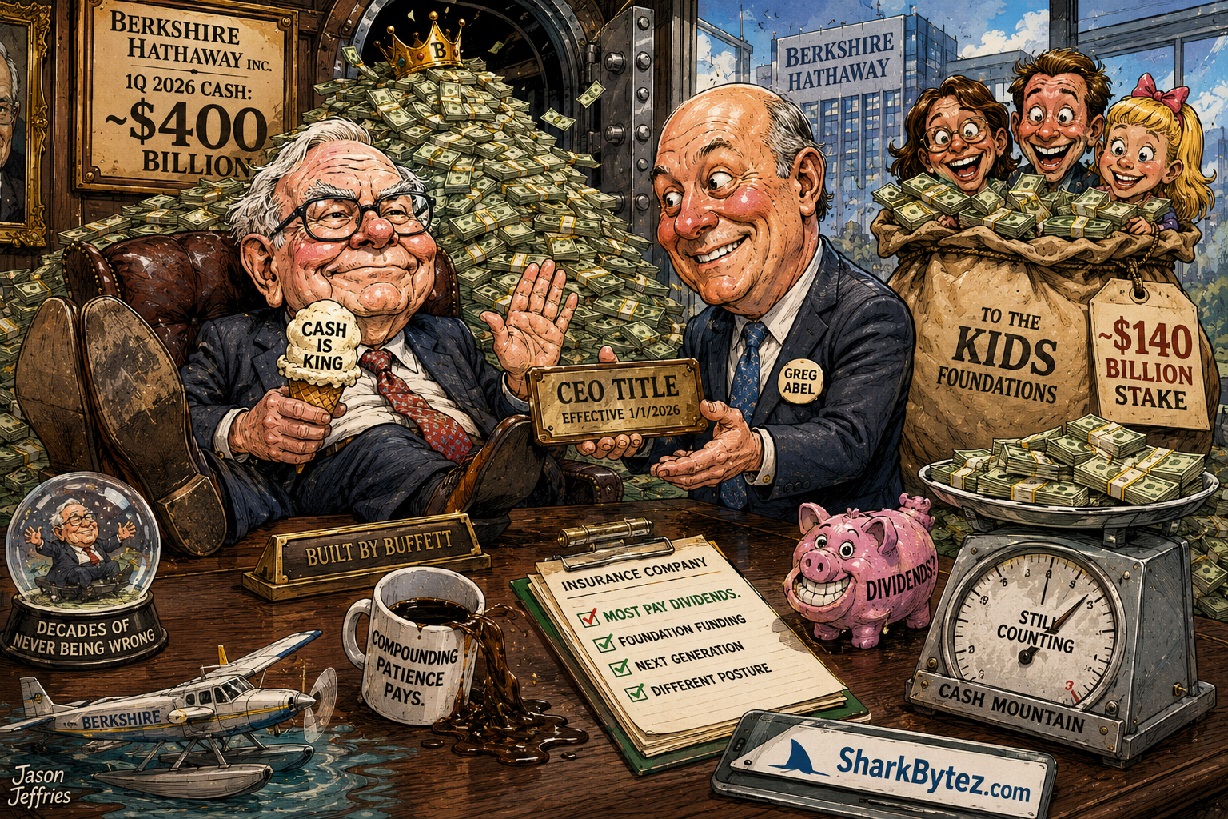
Berkshire Hathaway closed the first quarter of 2026 sitting on a cash pile so absurdly oversized it could almost demand its own corner office and expense account: nearly $400 billion. For decades investors treated that idle mountain like a national treasure because Warren Buffett was the man in charge and his track record made questioning the strategy feel like arguing with a calculator that had never once been wrong. Then the calendar flipped. Buffett handed the CEO title to hand-picked successor Greg Abel at the start of the year. At the same time he began shifting his enormous ownership stake toward foundations controlled by his own children. Nothing detonates overnight, but the long game just acquired a very different posture.
Buffett remains the largest shareholder for now, which kept goals neatly aligned for a very long time. If he preferred cash over deals, the complaints stayed polite and far away. That neat alignment is slowly dissolving. The shares once headed for the Bill Gates foundation are now migrating toward the kids’ foundations instead. By 2034, or sooner if Buffett is gone, those foundations will control a stake worth roughly $140 billion. Foundations tend to like dividends. They convert ownership into steady funding without having to sell the underlying stock. Hormel and Hershey both learned that lesson from their own founder foundations and became reliable dividend machines as a result.
Berkshire is technically an insurance company. Most insurance companies pay dividends. The cash sitting on the balance sheet makes the arithmetic almost comically obvious. It would be entirely reasonable for the children, once they control that massive block, to suggest the company start sharing some of the wealth. The company might find it difficult to refuse a request backed by ownership the size of a small country. A dividend would also give the foundations a clean way to fund their work without dumping Berkshire shares into the market like leftover inventory.
While Buffett is still around, major changes remain unlikely. After he is gone, the dynamic shifts from quiet patience to something more pointed. The same cash hoard that once symbolized disciplined restraint could suddenly look like an oversized, unused toolbox to a new generation of large owners with different priorities. A dividend might even attract fresh investors who previously stayed away from a stock that never paid them anything. The outcome is not predetermined, but the pieces are already in place: a new CEO, a migrating ownership stake of staggering size, and a cash mountain that no longer has its original guardian fully in charge. The quiet era of unquestioned cash accumulation is entering its final, slightly awkward chapter.