

Michael Burry’s 1987 Crash Warning Debunked
Not financial advice. For satirical purposes only.
Wall Street sneezes and the same moldy prophecy gets hauled out like a dusty skeleton in a cheap suit. Michael Burry, professional seer of Substack nightmares, just flapped the Black Monday banner again and warned that a 1987-style equity collapse might be lurking around the corner. Instantly the espresso brigade gripped their ceramic weapons and stared at green numbers as if the market itself had grown fangs and was circling the portfolio.
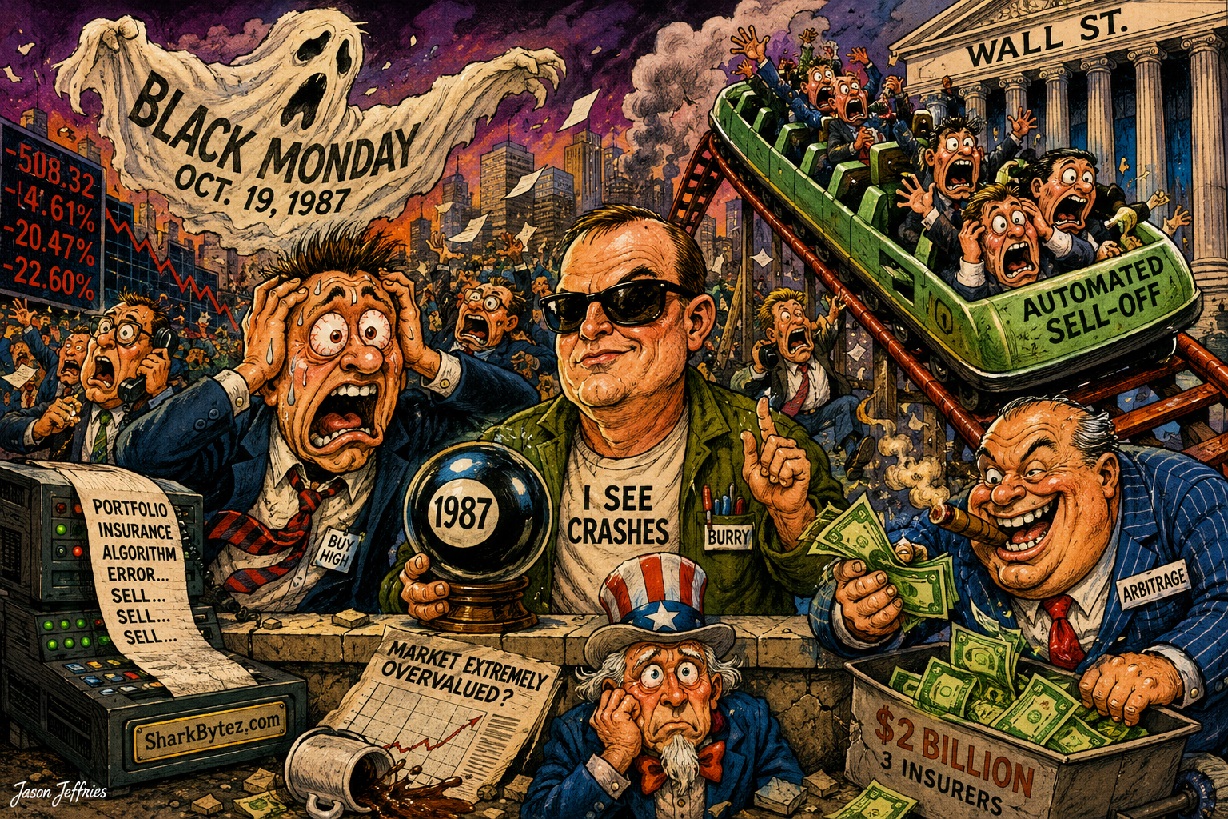
Black Monday remains the ultimate capital-markets ghost story: October 19, 1987, the Dow freefell 22.6 percent and the S&P 500 plunged 20.47 percent in one frantic session, recession nowhere in sight. Today’s valuation watchers squint at the same stretched multiples and decide the trapdoor is already greased, hinges oiled, and waiting for the next poor sucker to step on it. Strip away the headlines and the comparison collapses under its own cartoon logic.
1987 was pure mechanical farce. Early portfolio-insurance algorithms behaved like over-caffeinated robots, dumping massive short futures the second prices blinked. Arbitrageurs spotted the mechanical selling, leaped ahead of it, and turned a dip into a self-propelled price avalanche. Out of $21 billion in NYSE volume that day, three institutional insurers alone shoveled $2 billion into the meat grinder. The market’s plumbing simply short-circuited under its own automated weight.
Modern exchanges were rebuilt specifically to strangle that kind of feedback loop. Circuit breakers now slam the gate if the S&P 500 slides 7 percent, 13 percent, or 20 percent. Automated price bands and synchronized clearing systems exist for one reason: to yank the power cord before any algorithm can stage a full-scale tantrum.
Macro scenery is equally mismatched. In 1987 the Federal Reserve was jackhammering rates higher; ten-year yields rocketed roughly 300 basis points in nine months, forcing stocks to compete with a 10 percent risk-free alternative that looked like free money. In 2026 the Fed lounges at 3.5–3.75 percent while the ten-year drifts near 4.6 percent. The competitive bar for holding equities sits dramatically lower.
Yes, the Shiller P/E towers near 42 versus 18.5 before Black Monday. A high multiple is not the same as a structural time bomb. Mid-1980s S&P 500 profit margins limped along at about 6 percent. By Q2 2026 they flexed to a record 14.8 percent. Yesterday’s heavy industrial and financial dinosaurs have been replaced by asset-light technology giants that print cash with the efficiency of a mint.
Mega-cap concentration and ordinary volatility remain real. But screaming that a pure 1987-style flash collapse is imminent ignores four decades of upgraded plumbing, fatter corporate margins, and entirely different rate physics. History is less theatrical: one dollar invested in U.S. stocks in 1871 survived nineteen market crashes and still compounded like a patient machine. Doom makes brilliant newsletter bait. Cold arithmetic keeps quietly favoring the long-term bulls.