

US Gold Revaluation 2026: Washington’s $1 Trillion Ledger Game
Not financial advice. For satirical purposes only.
**SharkBytez: Gold Revaluation 2026 — Washington’s $1 Trillion Paper Fantasy Still Leaves Private Holders Holding the Bag**
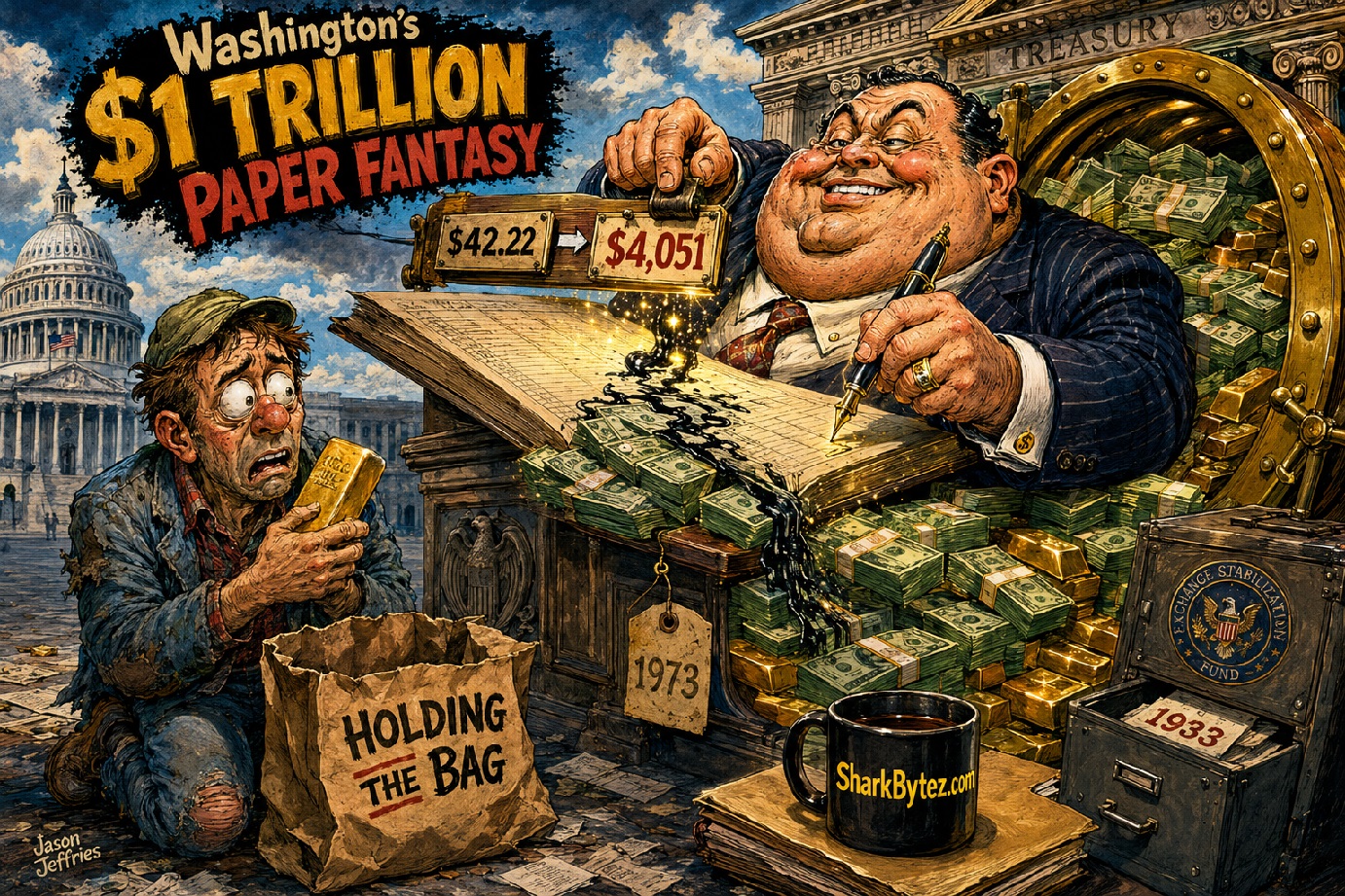
August 5, 2026. America’s official gold price remains locked at exactly $42.2222 an ounce, a number that has been gathering dust on the federal books since 1973. Market price this week hovered near $4,051. The United States holds 261.5 million fine troy ounces. On paper that metal is worth roughly $11 billion. At market it clears a trillion. The gap is so wide you can almost hear the accounting department sweating through its shirts.
Economic historian Phillip Magness has a blunt answer for anyone wondering who pockets the difference if the number ever moves. Look at the last time the government played this game. In 1933 Americans were ordered to surrender monetary gold at $20.67 an ounce. Nine months later the official price jumped to $35. Treasury booked a $2.8 billion accounting gain in 1934 dollars and poured two billion of it into the Exchange Stabilization Fund. The people who handed over the metal received exactly zero of that windfall. Private ownership stayed restricted for the next four decades.
That same fund was still shuffling currency last Friday, buying yen in a coordinated intervention. Ninety-two years after the revaluation that created it, the cash is still moving like it never got the memo that the party ended.
Magness calls any modern revaluation mostly an accounting stunt. Mark up the gold certificates sitting between Treasury and the Federal Reserve, credit the difference, and Washington suddenly has more purchasing power on the books without selling a single ounce. Markets, he notes, tend not to be impressed by ledger magic. The idea keeps floating back into circulation — most recently as one possible funding mechanism inside a bitcoin reserve bill — then drifts back to committee. Taxes remain political poison. Public debt is already knocking on $40 trillion. Currency tools and balance-sheet gymnastics keep looking like the easier path. The visual is pure comedy: a government that still values its own gold at a price last seen when Nixon was in office, sitting on a trillion-dollar difference, while private holders are told the upside belongs to the house. Magness sees little chance of another forced surrender. Laws that re-legalized private ownership act as a buffer. The original condition that made 1933 possible, he says, was the declaration of emergency. That is the part worth watching.
The pattern from history is consistent. When the official number finally moves, Washington books the gain. Private holders of physical metal are left staring at the short end of the deal. The paper fantasy is enormous. The distribution of benefits has never been subtle.