


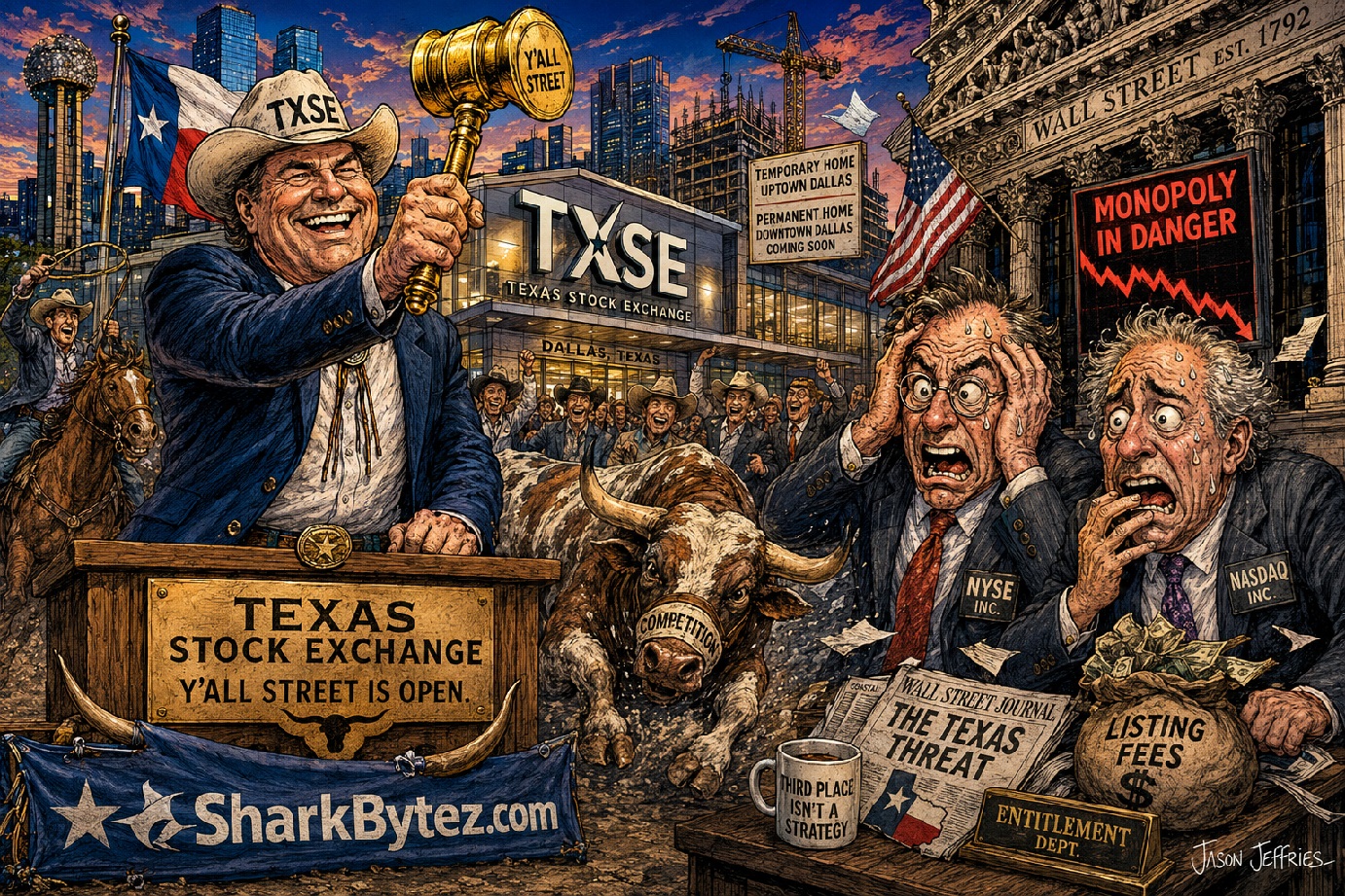
Texas Stock Exchange Launch: How TXSE Is Lassoing Wall Street’s Dominance
Not financial advice. For satirical purposes only.
Welcome to the financial rodeo of 2026, where the suit-and-tie elite in Manhattan just felt a cold breeze blast north from Texas, ruffling perfect hair and making tailored jackets suddenly feel too tight.
For the first time in modern memory, the closing bell did not ring in the cramped concrete canyons of lower Manhattan. It rang in Dallas, where Texas Stock Exchange CEO Jim Lee swung a ceremonial gold hammer like a man settling an old score and officially declared that “Y’all Street” is open for business.
While the exchange currently operates out of a temporary Uptown holding pen as its permanent downtown fortress rises floor by floor, this is no polite local experiment. It is a direct challenge aimed at the decades-long duopoly of the New York Stock Exchange and Nasdaq.
**Lone Star Capitalism vs. The Coastal Oligarchy**
The financial commentary class loves to pretend that real market liquidity can only exist near the Hudson River. Look past the traditional corporate arrogance and the motivation becomes glaringly obvious.
Corporate boards have grown exhausted by endless coastal bureaucracy, performative listing requirements, and punitive fee structures that feel more like toll booths than services. For the first time in generations, major corporations will have a genuine alternative for primary listings and capital raising. TXSE leadership is aggressively pushing to host exchange-traded funds before the year expires, clearing the runway for full initial public offerings by 2027.
When Jim Lee called the launch “pure infrastructure built to support what comes next,” he was not offering polite corporate rhetoric. He was planting a flag.
The sharper comedy is not that Dallas built an exchange. It is the quiet panic settling over Wall Street’s legacy institutions like sweat on a stiff collar. For half a century the incumbents treated listing fees like a birthright and corporate governance like their personal playground. Now they are forced to watch a zero-income-tax powerhouse erect a rival trading floor with deep pockets and zero patience for northern sermonizing.
Will Y’all Street completely dethrone the legacy giants overnight? Of course not. Systemic inertia is a heavy beast that does not move quickly. But as capital, corporate headquarters, and high-net-worth volume continue their relentless march toward the Sunbelt, the old guard’s monopoly is cracking in real time—visible stress lines and all.
The math remains stone-faced. Competition has finally arrived at the trading desk, dressed in boots and carrying a long memory of institutional entitlement. SharkBytez sees the spectacle clearly: loud bells, shifting capital, and Wall Street sweating through its perfectly tailored suits.