


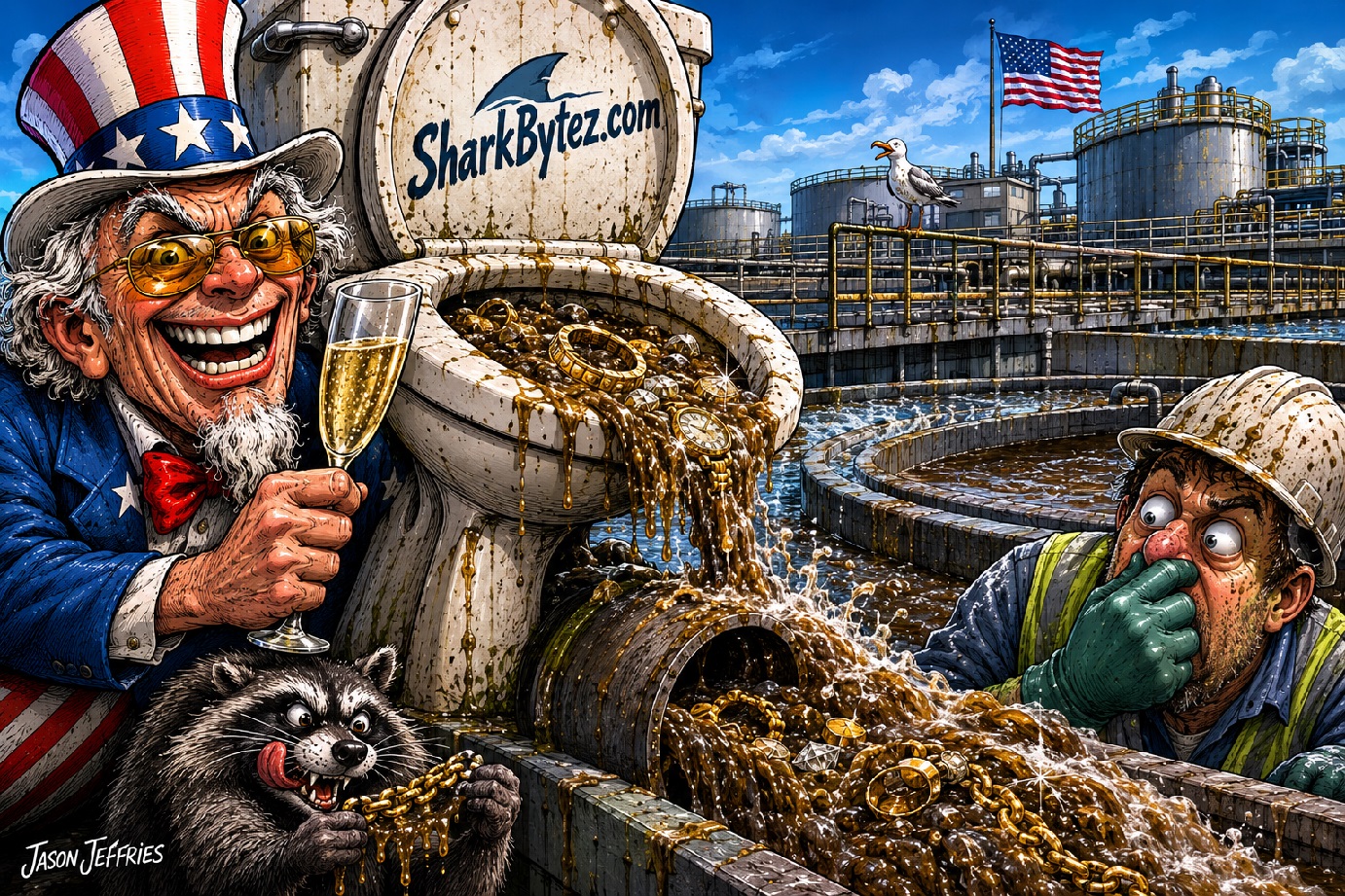
America’s Toilet Bowl Gold Rush: $13 Million in Hidden Metals Flowing Through U.S. Sewers
Not financial advice. For satirical purposes only.
America once chased fortune with tin pans and wild-eyed prospectors. Today the new mother lode arrives gift-wrapped in the daily flush. Researchers now insist U.S. sewers hold about $13 million in metals for every million residents, including a cool $2.6 million in gold and silver. The nation that conquered continents is currently marinating its treasure in municipal sludge.
Welcome to Urban Mining, Sewer Edition—the most American upgrade imaginable.A study in *Environmental Science & Technology* treated wastewater plants like accidental Fort Knoxe's. Every rinse of jewelry, every fleck from cosmetics, every industrial leftover drifts downstream and settles into biosolids. Scientists found 58 elements riding the current. Gold shows up at roughly one part per million—tiny, until you remember cities generate sludge the way tech firms generate press releases: nonstop and without shame.
The metals are there. The value is there. The dignity is not.Picture the numbers: roughly $280 of recoverable metal per tonne of sludge. On a spreadsheet it sparkles. In real life it sits tangled in organic matter, minerals, and the full spectrum of modern excess. Extracting it costs more energy, infrastructure, and olfactory courage than simply digging a hole in Nevada. The science is solid. The business case is a punchline delivered by a very patient raccoon.
Yet the hype machine keeps humming. Suddenly every treatment plant is a “resource recovery hub” waiting for its close-up. Phosphorus, nitrogen, and the occasional microscopic gold flake are rebranded as the circular economy’s greatest hits. The public personas of innovation cheer from the sidelines while the actual gold remains exactly where Americans left it—somewhere between the grit chamber and the landfill.
This is peak modern excess: we invent value, wear it, break it, then send it swirling into the dark with cheerful efficiency. The real treasure is not the metal. It is the spectacle of a country so proficient at wasting that its sewers now outperform many actual mines—while the recovery cost ensures nobody gets rich except the consultants writing the next feasibility study.
Somewhere a plant operator is staring at a mountain of biosolids worth millions on paper and zero in the bank. That single image captures the entire story better than any press release ever could.We consume, discard, and flush faster than we can calculate. And honestly? The absurdity fits us perfectly.