


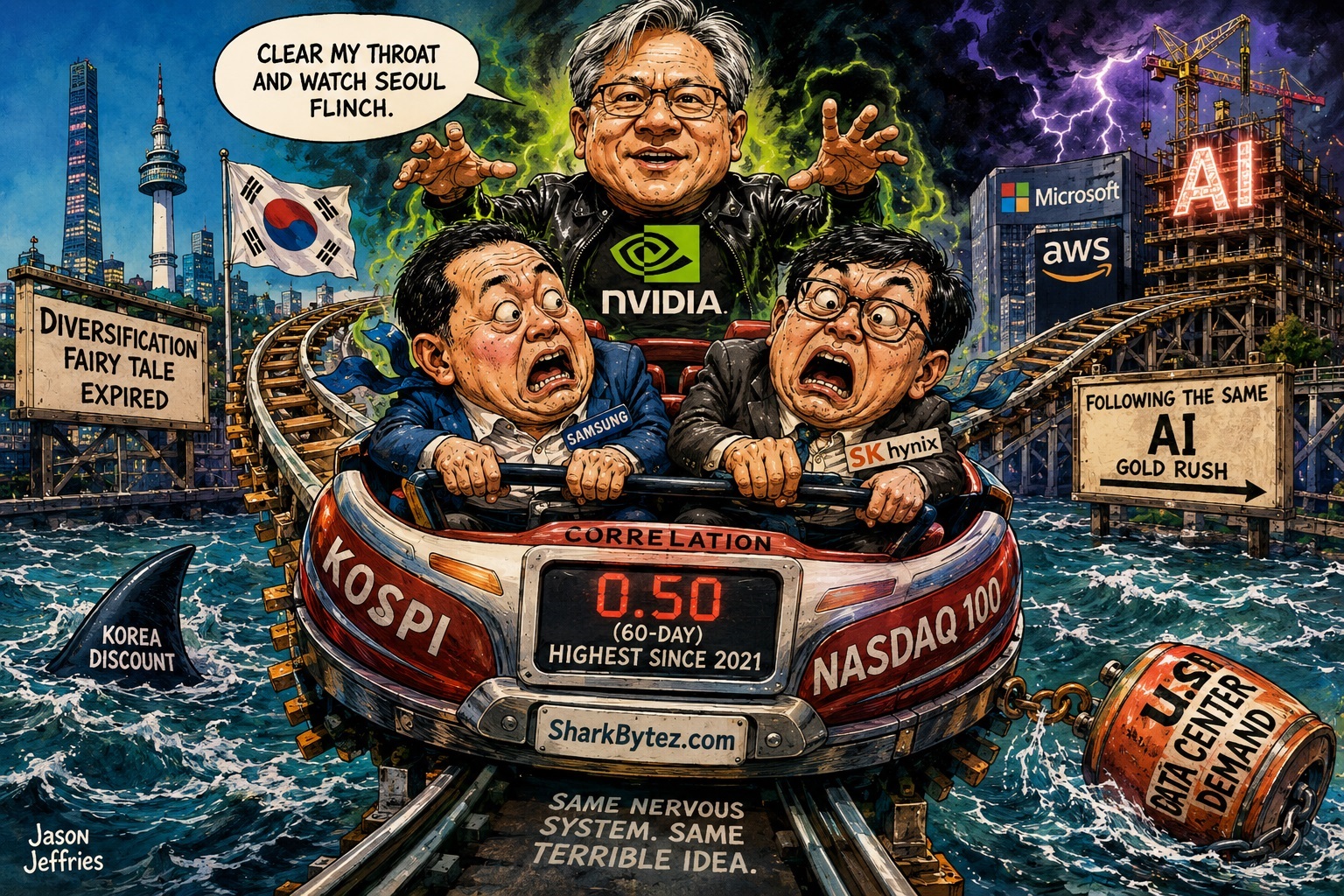
The geographic diversification fairy tale just got laughed out of the room.
Rayliant data shows the 60-day correlation between the Kospi and the Nasdaq 100 has hit 0.50 — the tightest since the 2021 tech sugar rush. Half the time these markets move like two people sharing one nervous system and one terrible idea. Portfolio managers still selling “Korea as your Silicon Valley escape plan” now look like the guy still pitching timeshares after the hurricane.
Samsung and SK Hynix are no longer exotic Asian adventures. They are the memory and chip pantry for the exact same AI gold rush that has Nvidia, Microsoft, and the rest of Santa Clara building data centers like the planet is running out of watts. When Jensen Huang so much as clears his throat, Seoul’s order books flinch on cue. The famous “Korea discount” is still printed on the menu. The actual diversification benefit was quietly taken off the table years ago.
This is not polite economic friendship. It is industrial Siamese twins sharing a bloodstream and a calendar. Korean high-bandwidth memory has become essential plumbing for American AI infrastructure. A slowdown in U.S. data-center spending does not politely stop at the ocean. It shows up in Seoul the same trading day, wearing the same worried face. Currency moves, local policy, even Korea’s domestic drama — none of it has been strong enough to pry these markets apart this cycle.
The joke writes itself. Investors once bought Korean tech to hedge Silicon Valley risk. They ended up buying Silicon Valley risk with extra currency turbulence, geopolitical seasoning, and thinner trading volume. U.S.-China export controls do not create helpful divergence. They simply synchronize the pain across both time zones. Trade policy has become a joint volatility machine with better branding.
Some still insist the coupling is temporary, a side effect of the current AI construction boom. Cute theory. It would carry more weight if Korean firms were spreading their bets. Instead they are doubling down on the exact same components that glue them to American hyperscale demand.
The blunt punchline: treating Samsung and SK Hynix as true geographic diversifiers is expensive nostalgia cosplay. A real Nasdaq correction will not respect the Pacific. Real diversification now means looking outside the semiconductor-AI complex that welded these two markets together. Everything else is just expensive theater with better lighting.