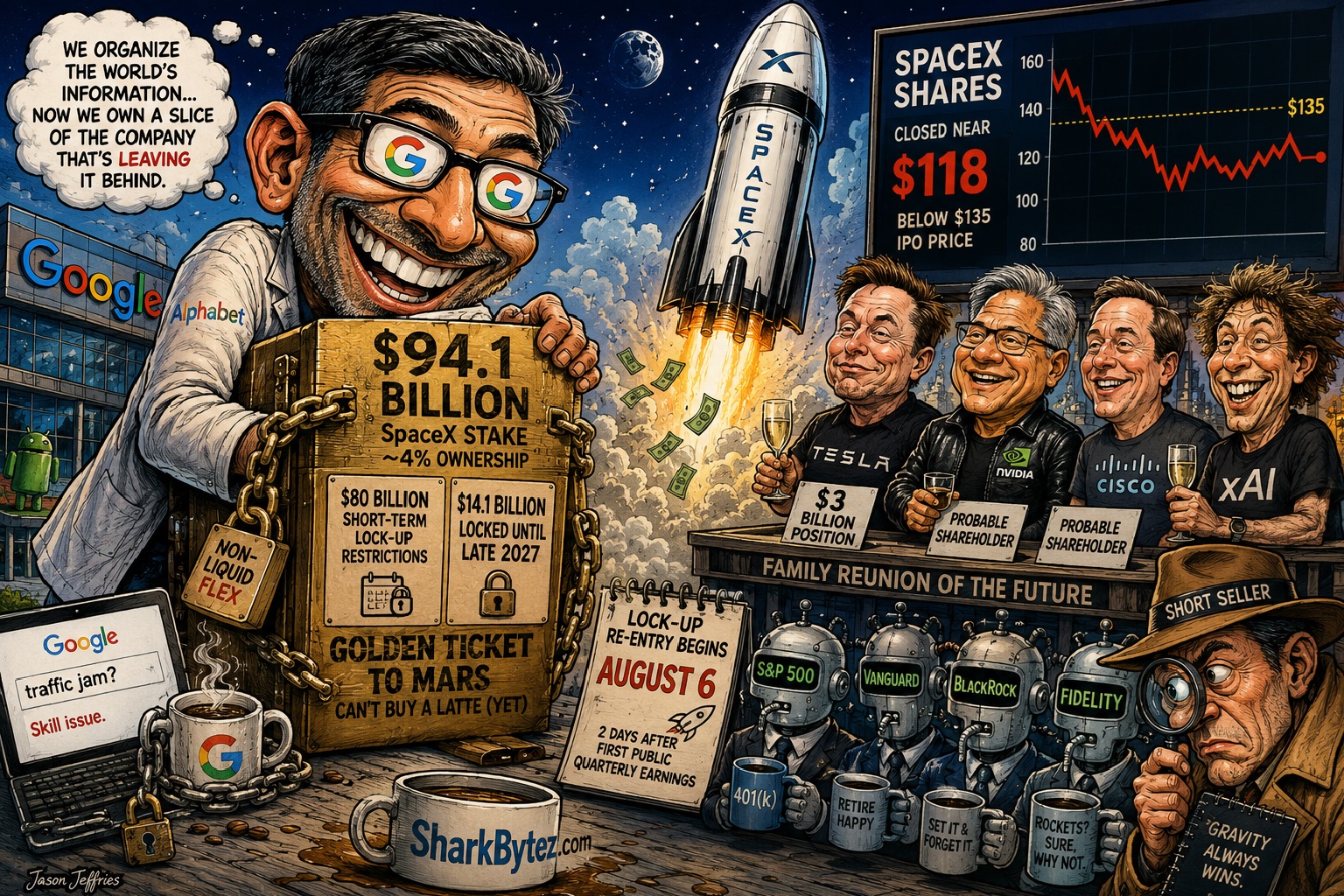
Somewhere between autocompleting your half-baked dinner recipe and calmly informing you that traffic is a personal failing, Alphabet parked a $94.1 billion stake in SpaceX. Roughly 4% of the company that just finished selling the public on the multi-planetary dream. The same corporation that once promised to organize the world’s information now owns a meaningful slice of the outfit promising to leave the world behind. Progress, or just the final evolution of corporate FOMO. Of that towering paper fortune, $80 billion sits under short-term lock-up restrictions. The remaining $14.1 billion stays padlocked until late 2027. Alphabet holds history’s most glamorous restricted asset: a golden ticket to Mars that cannot currently buy a single latte. The ultimate flex is ownership without the inconvenience of liquidity. Tesla rolled in with a modest $3 billion position. Nvidia and Cisco hover in the background as probable shareholders after the February corporate marriage of SpaceX and xAI.
The ownership chart now resembles a family reunion where every cousin somehow holds equity in every other cousin’s future. Incestuous? Absolutely. Efficient? Debatable. Entertaining? Undeniable. **The Looming Lock-Up Re-entry** Index funds, those serene robots of modern finance, have already vacuumed up the positions and distributed the risk to every retirement account that never asked for rocket exposure. Short sellers are studying the price action with the quiet intensity of people who have waited years for gravity to reassert itself. Shares recently closed near $118—comfortably beneath the $135 IPO price that once felt like destiny itself. The real spectacle begins August 6, two days after SpaceX delivers its first public quarterly earnings.
That is when the first wave of staggered lock-up expirations hits. The same tech titans who spent years narrating the future will finally be free to trade their tranches. Whether financial physics still applies to rockets will be stress-tested in real time, with everyday index investors along for the ride whether they booked the ticket or not. The search bar still works.
The rockets still launch. The paper gains remain mostly theoretical. And the market, ever the dry comedian, waits to discover who actually believed the hype when the locks finally open.