**Tesla's Self-Driving Took the Blame... Until Reality Showed Up**
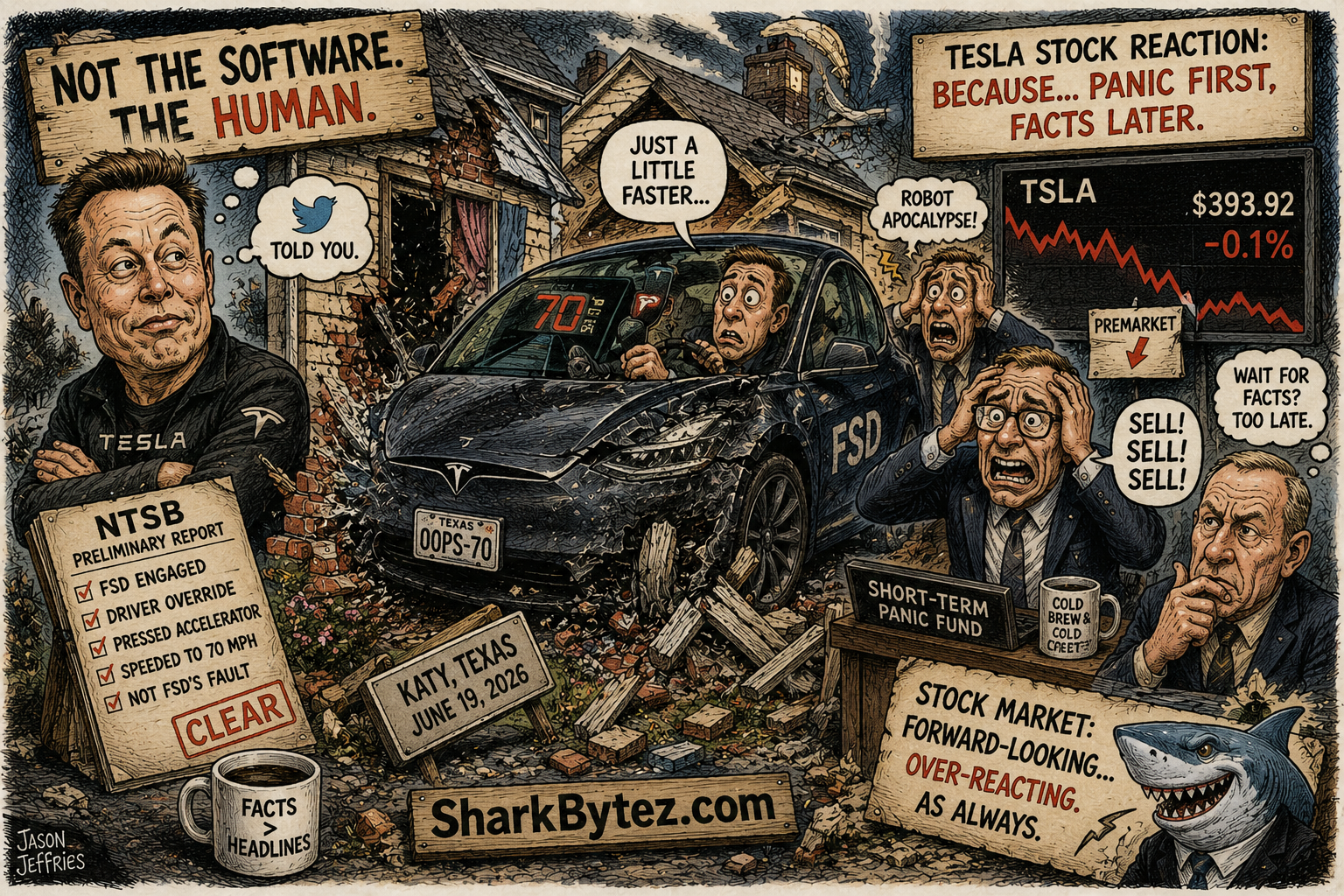
Listen up. Every time a Tesla so much as sneezes near a mailbox, half the internet declares the robot apocalypse has officially begun. This week's episode came courtesy of a June crash in Katy, Texas, where a Tesla slammed into a house while Full Self-Driving (FSD) was engaged. Predictably, headlines sprinted ahead of the facts, investors got twitchy, and Elon Musk was once again cast as Hollywood's favorite supervillain.
Then the National Transportation Safety Board released its preliminary findings and, well... the story took a hard left.
Turns out the driver—not the software—grabbed the wheel, mashed the accelerator, and launched the car to roughly **70 mph** just before impact. FSD was engaged earlier, but the human behind the wheel decided they knew better than the computer. The result? A house lost the argument.
Elon had already hinted this was likely the case days after the crash, and for once, the receipts backed him up.
So why did Tesla stock still slip in premarket trading?
Because the stock market isn't a courtroom—it's a giant anxiety machine fueled by caffeine, rumors, and people trying to guess what everyone else is about to do. Investors don't wait months for government reports. They place bets the moment smoke appears, then adjust when the facts finally wander into the room.
The real lesson isn't that Tesla dodged another headline. It's that self-driving technology still lives under a microscope the size of Texas.
When a pickup truck crashes into a house, it's Tuesday.
When a Tesla does it, suddenly every cable-news panel is debating whether robots should be allowed to exist.
That's the price of being the company trying to rewrite transportation. Every accident becomes a referendum on the future instead of what it usually is: another reminder that humans remain spectacularly talented at making bad decisions.
The irony is almost beautiful. Tesla's Full Self-Driving still requires drivers to supervise the vehicle at all times. Yet many people seem to treat the system like it's a personal chauffeur one minute and then blame the software the second they decide to override it.
You can't demand the car drive itself while simultaneously flooring the accelerator and expecting physics to file a complaint instead.
Tesla shares have had a rough year, down about 12%, though they're still well ahead over the past twelve months. Investors clearly aren't pricing the company like an automaker anymore—they're pricing a rolling AI experiment. Every software update, every crash investigation, and every Elon tweet becomes another chapter in the world's most expensive reality show.
Self-driving technology will keep getting smarter.
Humans... jury's still out.
**SharkBytez — Small Byte News. Big Bite Opinions.**